By Bill Wagner | April 4, 2026
For many older adults, the concept of "home" is synonymous with dignity and autonomy. As our population shifts, the collective desire to "age in place" has moved from a personal preference to a critical public policy priority. However, a significant barrier stands between millions of Americans and their ability to remain in their communities: affordable, reliable transportation.
At the Coordinating Council on Access and Mobility Technical Assistance Center (CCAM-TAC), we recognize that mobility is the invisible thread that connects individuals to healthcare, nutrition, social engagement, and economic vitality. Without it, the promise of independent living remains out of reach for many. Recent data highlights a stark reality: while 77% of older adults want to remain in their homes, 63% express deep concern about their ability to do so as they age. This anxiety is rooted in a fundamental challenge—the growing complexity and cost of staying mobile.
The Growing Cost of Staying Mobile
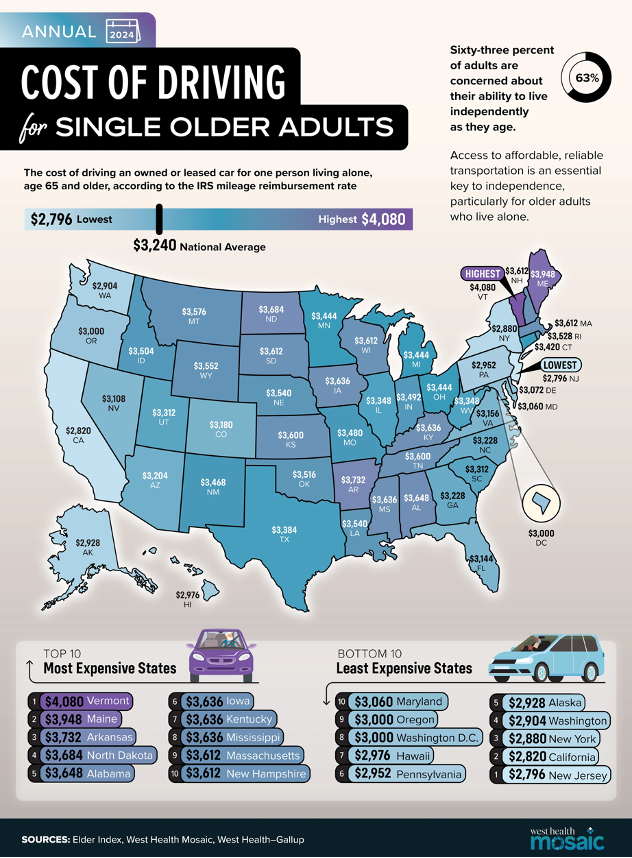
Economic barriers are often the first hurdle to independence. For many older adults living on fixed incomes, the financial burden of maintaining a private vehicle or paying for fragmented transit services can be overwhelming. According to data analyzed in The Link Between Affordable Transportation and Living Independently, the national average transportation cost for a single older adult is approximately $3,240 per year.
These costs are not uniform across the country, creating geographic disparities in mobility access:
- High-Cost Regions: In Vermont, older adults face some of the highest burdens, with annual costs reaching $4,080.
- Lower-Cost Regions: Conversely, New Jersey offers a lower average of $2,796 per year, often due to denser transit networks.
Perhaps most concerning is the fact that nearly 4 million households headed by adults age 65 and older do not have access to a vehicle at all. When personal vehicle ownership becomes unaffordable or physically impossible, the absence of a robust, coordinated alternative doesn't just limit travel—it creates isolation.
Aging in Place: A Community Goal
The drive to "age in place" is more than a sentimental wish; it is a pillar of community self-sufficiency. When older adults remain active and engaged in their neighborhoods, local economies thrive and the strain on institutional care facilities is reduced. However, the current landscape of independence is fragile. Approximately 43% of adults age 65+ live alone, and many in this demographic depend entirely on a personal vehicle to access life-sustaining services.
When an individual stops driving, their world can rapidly shrink. The data shows that 63% of adults are worried about this transition. This isn't just a personal crisis; it's a community challenge. If our infrastructure does not support those who can no longer drive, we risk losing the contributions of a vital segment of our population. To support the 77% who wish to stay in their homes, we must view transportation not as a luxury, but as a prerequisite for health and equity.
The Power of Coordinated Transportation
The solution to these mobility gaps lies in coordination. Traditionally, transportation services have operated in "silos"—different agencies managing medical transport, veteran services, and general public transit with little communication. This fragmentation leads to inefficient routes, wasted funding, and a confusing experience for the end-user.
CCAM-TAC advocates for a unified approach. By coordinating federal, state, and local resources, we can build a "multisector" system that puts the individual at the center. Key strategies currently being adopted across the country include:
- Multisector Plans for Aging (MPAs): States are increasingly implementing comprehensive frameworks that link housing, health, and transportation, ensuring that mobility is a primary consideration in all urban and rural planning.
- Interagency Resource Sharing: By pooling vehicles and funding from different federal programs, communities can offer more frequent and reliable service at a lower cost per trip.
- Technology-Enabled Mobility: Implementing "one-call/one-click" centers that allow older adults to see all available transportation options in one place, reducing the barrier to entry for those without personal vehicles.
| "Coordination is the catalyst for self-sufficiency. When we bridge the gap between agencies, we bridge the gap between an older adult and their community." |
Moving Forward: A Call to Action
As we look toward the remainder of 2026 and beyond, the mission of the Coordinating Council on Access and Mobility (CCAM) is more urgent than ever. The link between affordable transportation and independent living is unbreakable. To ensure that "aging in place" is a reality rather than a luxury, we must continue to advocate for policies that prioritize mobility coordination.
We call on policymakers, community leaders, and transit providers to:
- Prioritize Funding for Coordination: Support initiatives that break down silos between health and transportation sectors.
- Expand Specialized Transit: Focus on the 4 million vehicle-less households that are currently at the highest risk of isolation.
- Listen to the Community: Design systems that reflect the needs of the 77% of older adults who are striving to remain independent.
Join the Movement for Mobility
Are you a community stakeholder looking to improve transportation coordination in your area? Explore our technical assistance resources and learn how CCAM-TAC can help you build a more connected, self-sufficient community.
Visit CCAM-TAC.org to learn more. |
Reference
https://www.voronoiapp.com/healthcare/The-Link-Between-Affordable-Transportation-and-Living-Independently-7981
https://www.voronoiapp.com/healthcare/The-Link-Between-Affordable-Transportation-and-Living-Independently-7981